"The work and gift of Henry Cornish, gent 1640"
The life & death of Henry Cornish
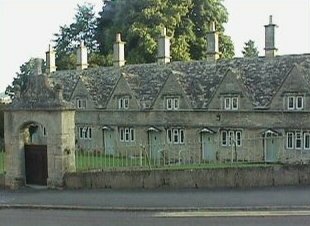
Henry Cornish died in 1650 but is still remembered in the town today as the founder of the beautiful almshouses in Church Street as well as having a street named after him. His ten-page will has recently been unearthed in the Public Record Office in London and transcribed into readable form from the 17th century script and quaint spelling of the original.
Named in Chipping Nortons royal charter of 1607 as one of the first members of the new Corporation which was to govern the town, he was clearly a man of property and considerable social standing in the community. His will describes him as a gentleman and shows that he owned many houses in the town including the White Hart Inn and others in High Street, Middle Row and Tite End (now Spring Street) as well as several pieces of land in the open fields. Near the White Hart he had a coneygree or rabbit warren, which is probably the origin of the name Coneygree Terrace today. In spite of this wealth his private life had many sadnesses. In about 1600 he married Sarah Browne, daughter of Thomas Browne who built Fletchers House in Woodstock (the present county museum), but although they had twelve children no fewer than ten died in childhood and the remaining two only lived into their thirties. There is a pitiful brass plate at the back of St Marys church commemorating the death of a son, named Henry after his father, who died aged nine.
The lack of surviving children was one reason why he left such generous bequests to the town, and to the poor of Woodstock, Stow on the Wold and Churchill who were all to receive cash payments on the day of his funeral. The other motive was his strongly held puritan belief in charity to the poor. The almshouses were provided at his own expense for eight aged widows who had to be of honest and godly life and conversation. In addition he left money to provide coats and gowns for two poor men and two poor women and fourpence each to 40 other widows. He bequeathed 12 other cottages around the town to be let to honest people who could afford to rent them, but stipulated that the rents should never be increased. At the other end of the social scale he also gave his fellow members of the corporation, the Bailiffs and Burgesses of Chipping Norton, money for an annual dinner at the White Hart (then the leading inn in the town) which became known as The Bailiffs Feast and was held for nearly two hundred years after his death.
After the death of his wife Sarah, Henry married again but less happily it seems. He explains in his will that he is writing it secretly with the help of friends to cancel any previous wills he had been forced to make under pressure from his second wife and her relations when he was old and ill. He left her money and a home during her life, but after that everything reverted to his own Cornish relations and to the Diston family to whom he was also related. His final request was that he should be buried in the middle aisle of the parish church, close to his son and daughter, and hopefully he rests there in peace to this day. His memory lives on in the community to which he gave so much.
Transcribing this will is part of the work of the recently formed Chipping Norton Research Group, a dedicated and skilled group who have embarked on the huge task of transcribing hundreds of Chipping Norton and Over Norton wills and inventories from the 17th century.
David Eddershaw
Reprinted from the Chipping Norton News.